Seoul DMZ Day Tour Guide (2026): Passport Rules, Dora Observatory, 3rd Tunnel & Local Travel Hacks
As a local living in Seoul, one of the most frequent questions foreign friends ask me is: "Is visiting the Demilitarized Zone (DMZ) worth it, and how do I actually go?" My answer is always an emphatic yes. Standing at the border between South and North Korea is a powerful, sobering, and utterly unique experience that you cannot replicate anywhere else in the world. Located just 50 kilometers (31 miles) north of downtown Seoul, the DMZ offers an eye-opening glimpse into Korean War history, modern geopolitics, and the enduring hope for peace.
However, because the DMZ remains an active military border zone under United Nations Command (UNC) and Republic of Korea (ROK) military jurisdiction, visiting requires strict adherence to security protocols, mandatory identity checks, and tight scheduling.
In this comprehensive 2026 local guide, I will walk you through everything you need to know to plan a smooth, stress-free DMZ day tour: from non-negotiable physical passport requirements to exploring the 3rd Infiltration Tunnel, looking into North Korea through binoculars at Dora Observatory, navigating military checkpoints, and booking the best hassle-free day trips from Seoul.
Before embarking on your northern journey, make sure your mobile connectivity is set up for live translation and map updates. You can Reserve Korea Unlimited eSIM/SIM online to ensure continuous signal even in northern border districts.
Key Overview & Essential DMZ Tour Facts at a Glance
| Feature | Details & Practical Requirements |
|---|---|
| Distance from Seoul | ~50 km (1 to 1.5 hours drive via Jayuro Highway) |
| Mandatory Document | Original Physical Passport (Digital photos or paper copies strictly forbidden) |
| Main Tour Destinations | Imjingak Park, 3rd Infiltration Tunnel, Dora Observatory, Dorasan Station |
| Typical Tour Duration | Half-Day (6–7 hours) or Full-Day (8–9 hours including Suspension Bridge) |
| Operating Days | Tuesday to Sunday (Closed every Monday & ROK Military Holiday) |
| Tour Pickup Points | Hongdae Station (Exit 8/9) & Myeongdong Station (Exit 1/6) |
| Photography Rules | Allowed at Imjingak & Dora Observatory outdoor deck; strictly forbidden inside 3rd Tunnel |
1. Non-Negotiable Rule: Original Physical Passport Required
Before packing your bag for the tour, double-check your passport. This is the single most critical rule of visiting the DMZ.

(Photo: Source - Korea Tourism Organization / Lee Beom-soo, KOGL Type 1)
When your tour bus reaches the Unification Bridge (통일대교 / Tongil-daegyo) checkpoint, South Korean Military Police (MP) soldiers will board the bus to physically inspect every passenger's identity document against the manifest registered with the United Nations Command.
- Physical Passport Mandatory: You MUST carry your physical original passport.
- No Exceptions: Smartphone photos, scanned printouts, drivers' licenses, or digital IDs will result in immediate denial of entry. If you forget your passport at your hotel, the military police will turn your bus back, and no refund will be issued.
- Validity Check: Ensure your passport is undamaged and valid for the duration of your stay in Korea.
- Dress Code & Decorum: Wear comfortable, conservative clothing. While strict military dress codes (formerly enforced for the JSA/Panmunjom area) are relaxed for standard DMZ tours, closed-toe walking shoes are essential, and clothing displaying political slogans, offensive graphics, or military camouflage pattern prints should be avoided.
2. Top Highlights of the DMZ Day Tour
A standard civilian DMZ tour in Paju covers four major historical and geopolitical sites. Here is what to expect at each location:
A. Imjingak Peace Park (임진각 국민관광지)
Imjingak is the final point accessible to civilians without going through military security clearance. Built in 1972 to comfort families separated during the Korean War, it serves as a central hub for peace monuments, historical relics, and cultural exhibits.
- Freedom Bridge (자유의 다리): The wooden bridge where nearly 13,000 South Korean POWs walked across to freedom following the 1953 Armistice Agreement.
- Riddled Steam Locomotive: A historic steam train riddled with over 1,024 bullet holes, left abandoned in the DMZ for over half a century after being derailed during battle.
- Mangbaedan Altar (망배단): A sacred altar where displaced families gather during Lunar New Year and Chuseok to bow toward their ancestral homes in North Korea.
- Imjingak Peace Gondola: An optional aerial cable car crossing over the Imjin River into the Civilian Control Zone (CCZ), offering panoramic views of the river basin and historic military bunkers.
B. The 3rd Infiltration Tunnel (제3땅굴)
Discovered in October 1978 following information provided by a North Korean defector, the 3rd Infiltration Tunnel is one of four known clandestine underground tunnels dug by North Korea beneath the Military Demarcation Line (MDL).

(Photo: Source - Korea Tourism Organization / Lee Beom-soo, KOGL Type 1)
Located 73 meters (240 feet) underground, the tunnel stretches 1.63 kilometers (1 mile) in total length and was designed to accommodate the surprise movement of up to 30,000 armed troops per hour into South Korea.
- Safety Gear & Safety Briefing: All visitors must wear protective hard hats before entering. The ceiling height lowers to around 1.6 meters (5 feet 3 inches) in places, so hard hats are essential to prevent head injuries against sharp granite rock.
- Walking vs. Monorail: Visitors descend into the tunnel either via a walking rubberized ramp (~350m steep incline) or a small monorail train. The walk back up the ramp is steep, so take your time if you have knee issues or low cardiovascular stamina.
- Blockade Barricades: You can walk approximately 265 meters inside the tunnel until you reach the concrete blockade wall built by South Korea, located just 170 meters from the actual Military Demarcation Line.
- Locker & Photography Rule: All personal belongings, including cell phones, cameras, backpacks, and smartwatches, must be locked in free visitor lockers before entering. Photography inside the tunnel is strictly illegal under ROK military law.
C. Dora Observatory (도라전망대)
Perched on top of Mount Dora, the Dora Observatory offers sweeping 360-degree views directly across the Demilitarized Zone into North Korea.
- What You Can See Through Binoculars: On clear weather days, high-powered binocular telescopes allow you to view:
- Kijong-dong (기정동): North Korea’s "Propaganda Village," featuring a 160-meter tall flagpole flying a massive North Korean flag.
- Kaesong Industrial Complex (개성공단): The now-suspended joint economic industrial park once co-operated by North and South Korea.
- Kaesong City Skyline: Distant views of North Korea’s fourth-largest city and Mount Songak.
- Statue of Kim Il-sung: High-magnification scopes reveal distant statues in rural North Korean farming communities.
- Photography Zone: High-resolution cameras and smartphones may be used on the outdoor observation terrace behind the marked safety line.
D. Dorasan Station (도라산역) & Unification Village (통일촌)
Dorasan Station is a ultra-modern train station built with the vision of connecting the Trans-Korean Railway (TKR) to the Trans-Siberian Railway (TSR), linking Seoul to Eurasia.
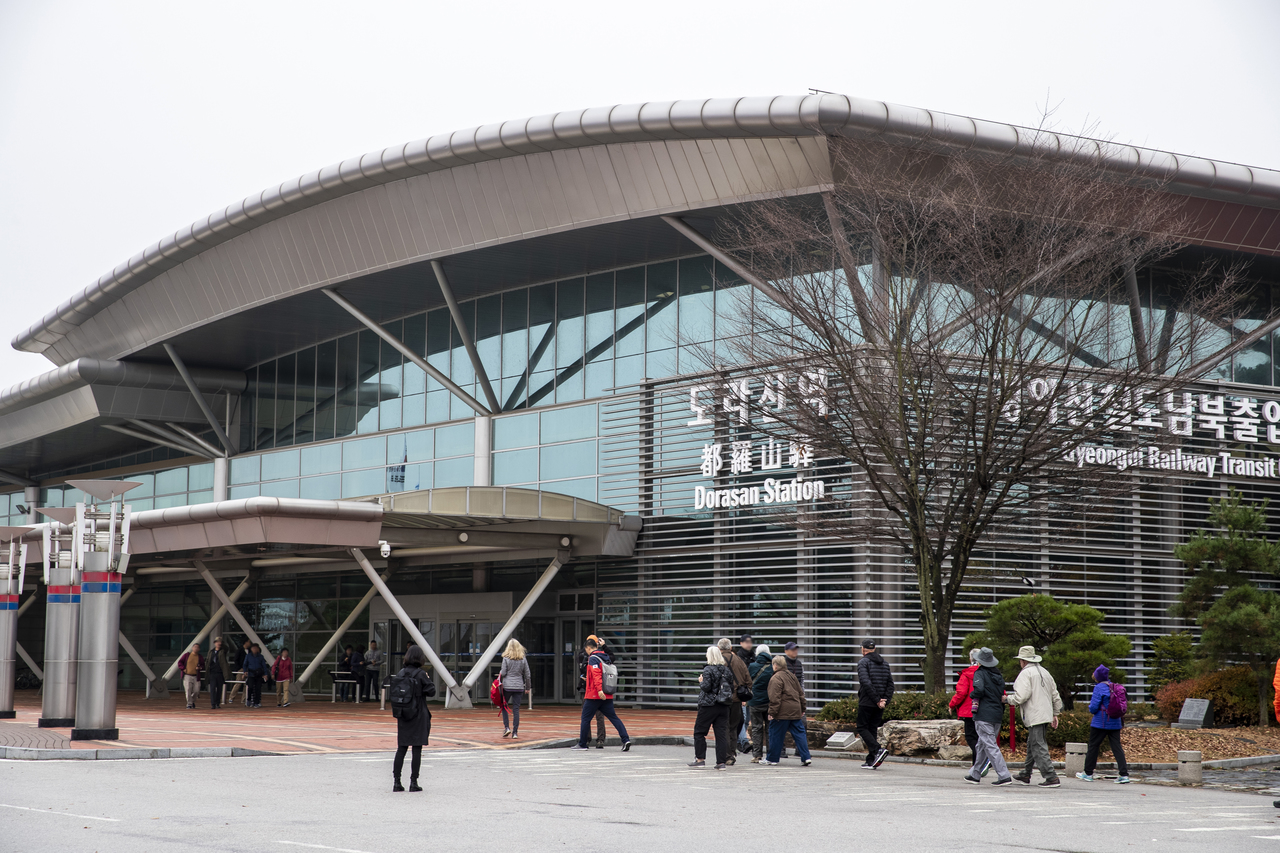
(Photo: Source - Korea Tourism Organization / Lee Beom-soo, KOGL Type 1)
- "Not the Last Station from the South, but the First Station toward the North": A famous sign in the main concourse encapsulates South Korea’s dream of peaceful reunification.
- Unification Village (Tongil Chon): A peaceful farming village situated inside the Civilian Control Zone. Local residents cultivate organic DMZ specialty agricultural products. You can sample and purchase local DMZ soybeans, soybean paste (Doenjang), wild ginseng, and locally distilled DMZ rice wine (Makgeolli).
3. How to Book & Choose the Right DMZ Tour Package
Because independent individual travel across military checkpoints is prohibited for non-residents, foreign visitors must join an authorized tour bus or book an official civilian entrance slot.
For guaranteed hassle-free transportation with native English guides and pre-allocated military access passes, we strongly recommend booking your spot in advance online:
- Book Official Seoul DMZ Day Tour Package: Includes roundtrip air-conditioned coach transportation from Myeongdong or Hongdae, English-speaking guide, 3rd Tunnel entrance fees, and Dora Observatory access.
Tour Options Comparison
| Tour Type | Estimated Duration | Key Inclusions | Best For |
|---|---|---|---|
| Half-Day Classic DMZ Tour | 07:00 – 14:00 (7 Hours) | Imjingak, 3rd Tunnel, Dora Observatory, Dorasan Station | Travelers with limited time who want core history |
| Full-Day DMZ + Suspension Bridge | 07:00 – 16:30 (9.5 Hours) | Classic DMZ + Gamaksan or Lake Majang Suspension Bridge | Nature lovers seeking scenic hiking trails & photo spots |
| Private Custom DMZ Tour | Flexible (8 Hours) | Dedicated private vehicle, flexible pace, customized lunch stop | Families, small groups, or private business travelers |
4. Practical Local Tips & Etiquette
To get the most out of your DMZ day trip, keep these practical tips in mind:
- Book Early (At least 3-7 Days Ahead): Due to strict daily quotas imposed by military authorities on civilian entry tickets, DMZ tours frequently sell out during peak spring (April–May) and autumn (September–November) travel seasons.
- Morning Pickups Start Early: Most morning tour coaches depart from Hongdae or Myeongdong between 06:30 AM and 07:30 AM. Arrive at your designated pickup exit 10 minutes early; buses cannot wait for late passengers due to strict military entry window slots.
- Wear Layers & Flat Shoes: The 3rd Tunnel maintains a cool temperature (~12°C to 14°C) year-round, but the walk back up the incline will make you warm. Dress in comfortable layers and wear flat sneakers with good grip.
- Bathroom Stops: Use the restrooms at Imjingak Park before boarding the bus into the Civilian Control Zone. Facilities inside military zones are limited.
- Respect Military Personnel: Avoid taking photos of ROK soldiers, military guard posts, wire fences, or military hardware at checkpoints unless explicitly permitted by your tour guide.
Summary Checklist Before You Leave Your Hotel
- [ ] Original Physical Passport packed in your daypack (Double-check!).
- [ ] Comfortable walking shoes (No loose flip-flops).
- [ ] Layered clothing suited for seasonal outdoor weather and cool tunnel walk.
- [ ] Charged smartphone & power bank for photos at permitted outdoor zones.
- [ ] Active Korea Unlimited 4G/eSIM Pass for live translation & maps.
Visiting the Korean DMZ is a memorable, profound journey into the heart of modern history. By following these local guidelines and reserving your tour pass early, you will experience an unforgettable day exploring one of the world's most unique historical boundaries.


